
Have you always been captivated by the expressive characters in your favorite
To draw
This guide is built on a “Zero to Hero” framework that has helped countless beginners. It’s a comprehensive curriculum designed to take you from basic shapes to fully realized characters. You will discover the exact step-by-step methods needed to bring your creative visions to life on the page.
Key Facts
- Drawing is a Learnable Skill: Success in
manga art comes from structured practice and understanding foundational principles, not from innate talent. Studies in skill acquisition show that consistent effort is the primary driver of improvement.- Proportions Follow a System:
Manga characters are built using a “head-count” method, where the body’s height is measured in multiples of the head’s size, typically 7-8 heads tall for a standard hero. This provides a consistent framework for all your characters.- Eyes Convey Most of the Emotion: The large, expressive eyes are the most iconic feature of the
manga art style. The shape, pupil size, and light reflections are used to communicate a character’s personality and feelings with incredible depth.- Tools Don’t Make the Artist: While professional tools exist, you can start drawing high-quality
manga with just a basic pencil and paper. Digital art offers flexibility, but the fundamental skills of line control and form are the same across both traditional and digital mediums.- Consistency Outweighs Intensity: Industry analysis reveals that short, daily practice sessions are more effective for long-term skill development than infrequent, long drawing sessions. Just 30 minutes a day builds muscle memory and reinforces learning.
How to Draw Manga Drawing: A Step-by-Step Guide for Beginners?
Learning how to draw

This comprehensive curriculum is framed as a “Zero to Hero” journey. We’ll start from the absolute ground floor, acknowledging the common challenges every beginner faces. From there, we will build your skills systematically. You will learn everything from gathering the right tools to constructing faces, mastering body proportions, and creating dynamic poses.
Forget the idea that you need to be born with talent. Drawing
What Essential Tools and Supplies Do You Need for Drawing Manga ?
Beginners drawing
Here are the must-have tools for starting your
Traditional Drawing Tools
- Pencils: You need at least two types. A hard lead pencil (like an HB) is for light sketching and guidelines. A softer lead pencil (like a 2B or 4B) is for darker, more defined lines. Non-photo blue pencils are also excellent for sketching, as scanners may not pick them up.
- Erasers: A good quality kneaded eraser is essential. It can be molded to a fine point for small details and won’t smudge your lines like a standard rubber eraser. A pen-style eraser is also great for precision.
- Paper: For practice, any standard copy paper will do. For finished work, use a smooth, heavy paper like Bristol board. Bristol board is a type of very smooth and thick paper that is ideal for inking because it prevents the ink from bleeding.
- Fineliner Pens: To ink your drawing, you need a set of black fineliner pens in various sizes (e.g., 0.1mm for details, 0.3mm for main lines, and 0.5mm for bold outlines).
Digital Drawing Tools
- Drawing Tablet: This is the most important piece of equipment for digital art. Entry-level tablets from brands like Wacom, Huion, and XP-Pen are affordable and highly effective for beginners. The best drawing tablets for beginners in 2026 often come bundled with software.
- Art Software: Clip Studio Paint is the industry standard for
manga creation due to its specialized tools for paneling, tones, and line work. However, excellent free alternatives like Krita and Medibang Paint are perfect for starting out. For iPad users, Procreate is a powerful and popular choice.
Budget Tip: You don’t need to buy everything at once. You can create amazing
manga art with just a single pencil and a stack of printer paper. Focus on mastering the skills first, then invest in more advanced tools.
| Feature/Aspect | Traditional |
Digital |
|---|---|---|
| Initial Cost | Low (Pencils and paper are inexpensive) | High (Requires a tablet and software) |
| Recurring Costs | Medium (You need to replace ink, pens, and paper) | Low (Software is often a one-time purchase) |
| Flexibility | Low (Mistakes are permanent and harder to fix) | High (The undo button, layers, and transform tools offer total freedom) |
| Learning Curve | Gentle (Most people have experience using a pencil) | Steep (Requires learning how to use the software and tablet) |
| Best For | Practicing fundamental line control and building confidence | Professional work, coloring, special effects, and easy editing |
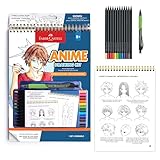
How Do You Draw the Basic Manga Head and Face?
To draw a
The face is the focal point of any
Step 1: How Do You Construct the Basic Head Shape and Guidelines?
To construct a
- Start by drawing a perfect circle. This will form the cranium, which is the top part of the skull.
- Draw a vertical line from the bottom of the circle downwards. The length of this line should be about half the height of the circle. This point marks the chin.
- Draw two diagonal lines from the sides of the circle down to the chin mark. These lines form the jawline. You can make them sharp for a male character (shonen style) or soft and rounded for a female character (shoujo style).
- Draw a vertical line down the exact center of the entire head shape. This is your centerline, and it ensures the face is symmetrical.
- Draw a horizontal line across the exact middle of the entire shape (from the top of the head to the chin). This is your eyeline. In
manga , the eyes are placed much lower than in realistic art.
Pro Tip: Use a light pencil or a non-photo blue pencil for these guidelines. This allows you to easily erase them after you’ve inked the final lines of your drawing.
Step 2: How Do You Draw Expressive Manga Eyes?
To draw
The beauty of
- Shonen Style: Often seen in action
manga , these eyes are typically sharper, narrower, and more angular. They convey determination and intensity. - Shoujo Style: Common in romance
manga , these eyes are very large, round, and filled with detailed reflections and highlights. They emphasize emotion and vulnerability. - Chibi Style: For cute, simplified characters, the eyes are massive, simple ovals with very large, basic light reflections.
The emotion of the eye is controlled by the eyelid and eyebrow. A downward curve in the upper eyelid can show sadness or tiredness, while a high arching eyebrow can show surprise.
Pro Tip: The position of the light reflection (the white ‘shine’) should be consistent in both eyes. If the light is coming from the top left, the shine should be in the top left of both the right and left iris. This small detail makes your drawing look much more professional.
How Do You Master Manga Body Proportions and Poses?
To draw a
After mastering the face, drawing a full body can seem daunting. However, professional artists use a simple trick to keep proportions consistent: the head-count method. A typical
- 1 Head: The head itself.
- 2 Heads: The chest line.
- 3 Heads: The waist/navel area.
- 4 Heads: The hips and crotch.
- 6 Heads: The knees.
- 7.5 – 8 Heads: The feet.
To create poses that feel alive and not stiff, you must use a Line of Action. This is a single, flowing curved line that runs through the body and represents the character’s energy and movement. Before drawing anything else, sketch this line on your paper. Then, build a simple stick-figure skeleton along that curve. This ensures your character has a natural rhythm and flow. A common pose using this principle is “Contrapposto,” where the character puts their weight on one leg, causing their shoulders and hips to tilt in opposite directions.
Practice Drill: Grab a piece of paper and draw 10 different curved lines—some S-curves, some C-curves. Then, challenge yourself to build a simple stick-figure pose on top of each one, following the flow of the line. This is the fastest way to learn how to create dynamic poses.
What Are the Next Steps After Learning the Basics?
After learning basic
Once you are comfortable drawing faces and bodies, you have built a strong foundation. But the journey of an artist never truly ends. Here are the key areas to focus on to continue your growth and move toward mastery.
Study Advanced Art Fundamentals
The basics you learned are just the beginning. Now it’s time to deepen your knowledge.
* Perspective: Learn one-point, two-point, and three-point perspective to create believable backgrounds and environments for your characters.
* Composition: Study how to arrange elements on a page to create a visually appealing image that guides the viewer’s eye. This is how you create powerful illustrations.
* Color Theory: Whether you work traditionally with markers or digitally, understanding how colors interact will bring your artwork to life.
Learn the Art of Storytelling
Manga is not just about drawing cool characters; it’s about telling stories.
* Storyboarding and Paneling: Learn how
* Creating Original Characters (OCs): Move beyond fan art and start designing your own unique characters with distinct personalities and backstories.
Build a Portfolio and Join a Community
To grow as an artist, you need feedback and a place to showcase your work.
* Build a Portfolio: Select your 5-10 best pieces of work and create an online portfolio on a site like ArtStation. This is your resume as an artist.
* Join a Community: Platforms like Reddit (r/learnart), DeviantArt, and Instagram have vibrant art communities. Sharing your work and getting constructive criticism from other artists is one of the best ways to improve. Following professional
FAQs About how to draw manga drawing
How long does it take to learn how to draw manga ?
The time it takes varies greatly, but with consistent practice of about 30-60 minutes daily, most beginners can see significant improvement in their
Can I learn to draw manga if I’m not good at drawing?
Yes, absolutely. Drawing is a learned skill, not an innate talent. The step-by-step methods used for drawing
What is the difference between shonen and shoujo art styles?
Generally, shonen (targeted at boys) features characters with sharper, more angular eyes and jawlines, emphasizing action and dynamic poses. Shoujo (targeted at girls) typically uses characters with very large, round, and detailed eyes, softer features, and a focus on emotion and relationships. However, these are just conventions, and many modern
Do I need an expensive drawing tablet to draw manga digitally?
No, you do not need an expensive tablet to start. Many entry-level tablets from brands like Wacom, Huion, or XP-Pen offer excellent functionality for beginners for under $100. Even free software like Krita or Medibang Paint can produce professional-quality art. Start with affordable gear and upgrade only when you feel your tools are limiting your skills.
What’s more important to learn first: anatomy or perspective?
For character-focused
How do I practice drawing hands, since they are so difficult?
The key to drawing hands is to simplify them into basic shapes first. Think of the palm as a square or trapezoid block, and the fingers as three-part cylinders. Practice by tracing your own hand in different poses, focusing on the shapes and joints. Using references and breaking them down this way makes it much less intimidating.
Should I copy other artists’ manga styles?
Copying to learn (studying) is a valuable exercise, but you should not claim the work as your own or develop a style that is a direct imitation. The goal is to understand why an artist makes certain choices. Analyze your favorite artists, then try to incorporate elements you like into your own unique style.
How do I draw manga hair?
Think of
How can I make my characters look more ‘anime’ or ‘manga’?
The most defining
What is a ‘line of action’ and why is it important?
A line of action is a single, flowing curve that defines the energy and movement of a character’s pose. Drawing this line before you draw the character helps you avoid stiff, lifeless poses. It forces you to think about the character’s entire body as one dynamic unit, which is crucial for action-oriented
Key Takeaways: How to Draw Manga Drawing Summary
- Start with Structure, Not Detail – Always begin your drawings with simple shapes and guidelines (like the circle-and-jaw method for heads) before adding any details. This ensures correct proportions and symmetry from the start.
- Proportions are Key – Master the “head count” method for bodies and the rule of placing eyes halfway down the head. Correct proportions are more important than any single feature for making a character look right.
- Simplify Complex Parts – Break down difficult subjects like hands and hair into simpler geometric forms (blocks, cylinders, clumps). This makes them manageable and is a core technique used by professional artists.
- Digital or Traditional, Fundamentals are the Same – Whether you choose a pencil or a tablet, the core skills of anatomy, perspective, and line control are universal. Tools are secondary to a solid understanding of art fundamentals.
- Embrace the Line of Action – To avoid stiff characters, always start your poses with a single dynamic curve (the line of action). Building your character along this line will instantly make them feel more alive and energetic.
- Eyes are the Center of Expression – The size, shape, and details within a character’s eyes convey the vast majority of their emotion. Mastering different eye styles and expressions is a fast track to creating compelling characters.
- Practice is the Ultimate Tool – Consistent, deliberate practice is more valuable than any expensive pen or software. Focus on learning and applying one new concept at a time for steady, measurable improvement.
Final Thoughts on Your Manga Drawing Journey
Learning to draw
This guide has provided the foundational blocks: from constructing a face to posing a full body. The path forward is clear. Trust in these methods, be patient with yourself, and most importantly, have fun bringing your unique characters and stories to life. The page is blank and the tools are in your hands. It’s time to start drawing.
Last update on 2026-09-20 / Affiliate links / Images from Amazon Product Advertising API


